3 - Sensor Surfaces
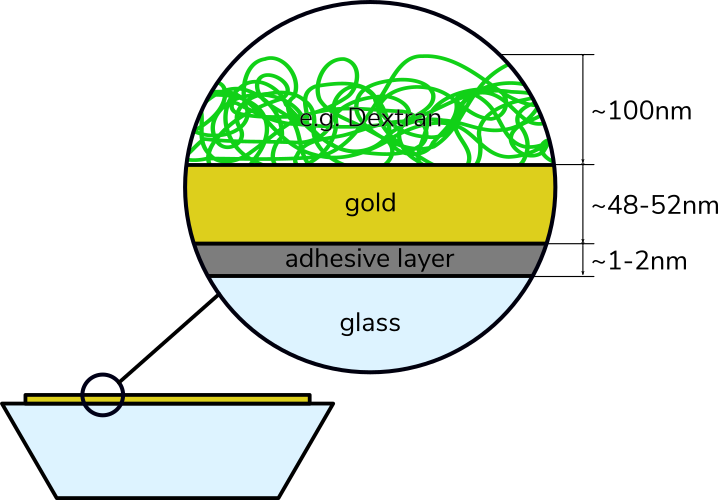
3.1 General build-up
3.2 Bruker sensor surfaces
- self-assembled monolayer with exposed COOH, 2D surface
- low immobilization levels; ~ 10-20% of the HCA immob level
- Large molecules, e.g. VLP, cells
- carboxymethylated dextran matrix exposing multiple COOH-groups, 3D surface
- medium – high immobilization levels; coupling via NH2, CHO, COOH, SH
- All types of biomolecules, e.g. lipids, proteins, nucleic acids
- carboxymethylated dextran matrix with pre-immobilized amine-NTA, 3D surface
- medium – high immobilization levels; coupling via His-Tag
- All types of biomolecules, e.g. lipids, proteins, nucleic acids
- carboxymethylated dextran matrix with pre-immobilized Neutravidin, 3D surface
- medium – high immobilization levels; coupling via Biotin-Tag
- All types of biomolecules, e.g. lipids, proteins, nucleic acids
- carboxymethylated dextran matrix with pre-immobilized Protein A/G, 3D surface
- medium – high immobilization levels;
- most subclasses of e.g. human-, mouse-, rat-, horse-IgG
- Contains a self-assembled monolayer with exposed CH3, 2D surface
- No detergents in running buffer as capture is mostly hydrophobic
- Large molecules, e.g. membranes, cells
Create your own surface with e.g. alkanthiols.
Order Number: 1862632 / 1862633
Order Number: 1862632 / 1862633